
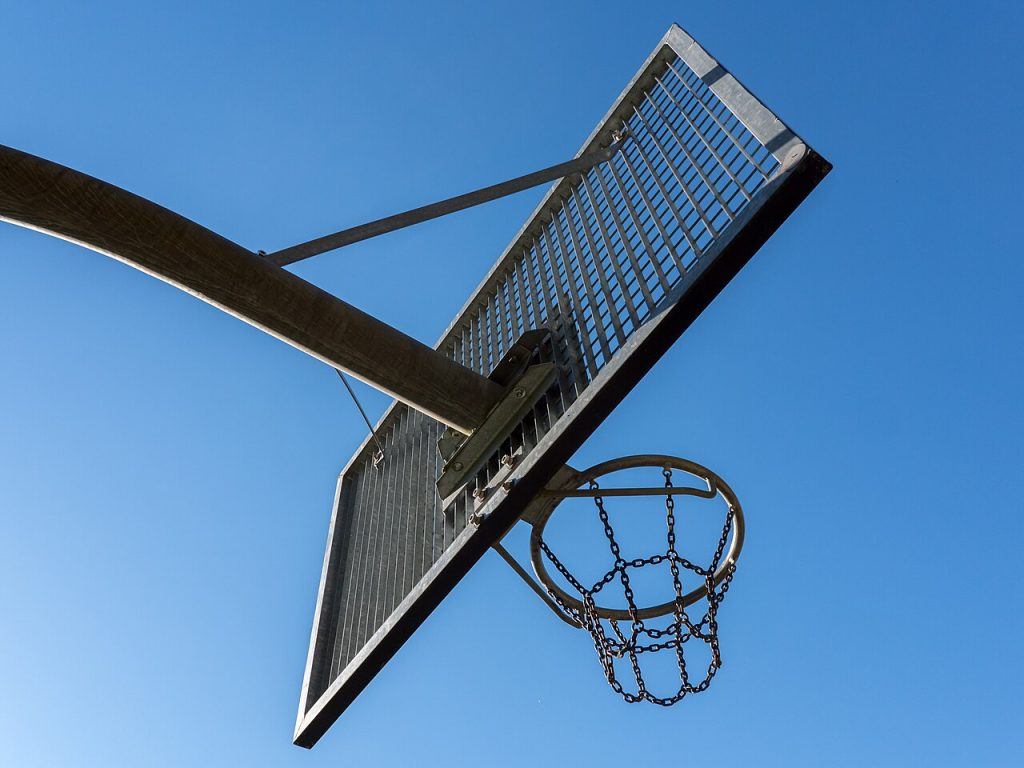
There are five traditional basketball positions: point guard, shooting guard, small forward, power forward and center. Each team has five players on court at a time, and the positions describe the usual job of each: guards handle the ball and shoot from range, forwards do a bit of everything and centers protect the basket. Modern teams are flexible, so a position is more a starting point than a rule.
The five basketball positions at a glance
| Position | Number | Typical role | Common traits |
|---|---|---|---|
| Point guard | 1 | Runs the offence | Ball handling, passing, vision |
| Shooting guard | 2 | Scores from distance | Shooting, off-ball movement |
| Small forward | 3 | All-round scorer and defender | Versatility, athleticism |
| Power forward | 4 | Rebounds and scores inside | Strength, physical play |
| Center | 5 | Anchors the paint | Height, rim protection, rebounding |
The numbers 1 to 5 are a common coaching shorthand for the basketball positions in that order.
Point guard (1)
The point guard is often described as the team’s floor general. This player usually brings the ball up the court, calls plays and decides who gets the ball and when. Good point guards see the whole court, pass accurately and keep the team organised under pressure.
Point guards tend to be quick and skilled at dribbling. On defence they often guard the opposing ball handler and try to disrupt the other team’s rhythm. Height is less important here than speed, control and decision making.
Shooting guard (2)
As the name says, the shooting guard’s main job is to score, especially from outside. They often play off the ball, moving around screens to get open for a shot. A reliable shooting guard forces the defence to stay spread out, which opens space for teammates.
Shooting guards are also expected to defend well on the perimeter and, in many teams, to handle the ball when the point guard needs a break.
Small forward (3)
The small forward is usually the most versatile player on the floor. They score from different areas, drive to the basket, shoot from range, rebound and defend several kinds of opponents. Teams often look for athletic players with a bit of everything for this role.
Because of this flexibility, small forwards can slide into other positions when a coach wants a different look.
Power forward (4)
The power forward plays closer to the basket than the guards and small forward. Traditionally, this means rebounding, setting screens, scoring around the rim and defending bigger opponents. The role has changed in recent years, and many power forwards now shoot from outside as well.
Strength and screens
One of the unseen jobs of a power forward is the screen. A good screen holds a defender in place for a moment so a teammate can shoot or drive. It rarely shows up in a scoreboard summary, yet coaches value it highly.
Center (5)
The center is typically the tallest player on the team and the main presence near the basket. On offence, centers score close to the rim, set screens and grab offensive rebounds. On defence, they protect the basket by contesting or blocking shots and securing defensive rebounds.
Some modern centers also pass well from the high post or shoot from distance, and this has changed how teams build their line-ups.
Do basketball positions still matter?
Basketball positions still give a useful vocabulary, but many coaches now speak of roles instead. Teams may use a “small-ball” line-up with no traditional center, or play a tall player as a playmaker. You will also hear the terms “guard”, “wing” and “big” as three broader groups:
- Guards: point guards and shooting guards who handle the ball and shoot from the outside.
- Wings: small forwards and some shooting guards who move along the sides of the court.
- Bigs: power forwards and centers who work close to the basket.
The skills that matter most for any position today are shooting, passing, defending and decision making. A player who can do several of these can fill more than one role.
Finding your place among the basketball positions
If you are new to the game, try different roles before settling. Taller players might begin near the basket, and quicker players might begin as guards, but practice can change that. Many youth coaches encourage players to learn all the basics before specialising. Good conditioning helps in any role, and a quick warm-up before sport is worth doing before every game.
For more on how team games work, you might enjoy our explainer on the offside rule in football, or browse the sports category.
Frequently asked questions
Further reading: Wikipedia overview: Basketball positions.

Written by Templates Hub
The Templates Hub editorial team writes practical, plain-English guides on law basics, health, lifestyle, business and sports, alongside free website templates and themes. Articles are general information and are reviewed for clarity before publishing.
More articles by this author →
Couch to 5K: An 8-Week Beginner Running Plan
A gentle eight-week plan that takes you from no running to jogging for 25 to 30 minutes, with…
A Short History of the Olympic Games
From ancient Olympia to modern host cities, a short guide to how the Olympic Games began, stopped and…

How to Warm Up Before Sport: A Simple 10-Minute Routine
A simple, equipment-free 10-minute warm-up covering easy cardio, dynamic mobility moves and sport-specific drills.
The Offside Rule in Football Explained Simply
A plain-English guide to the offside rule in football: what counts as offside, when it does not apply…