
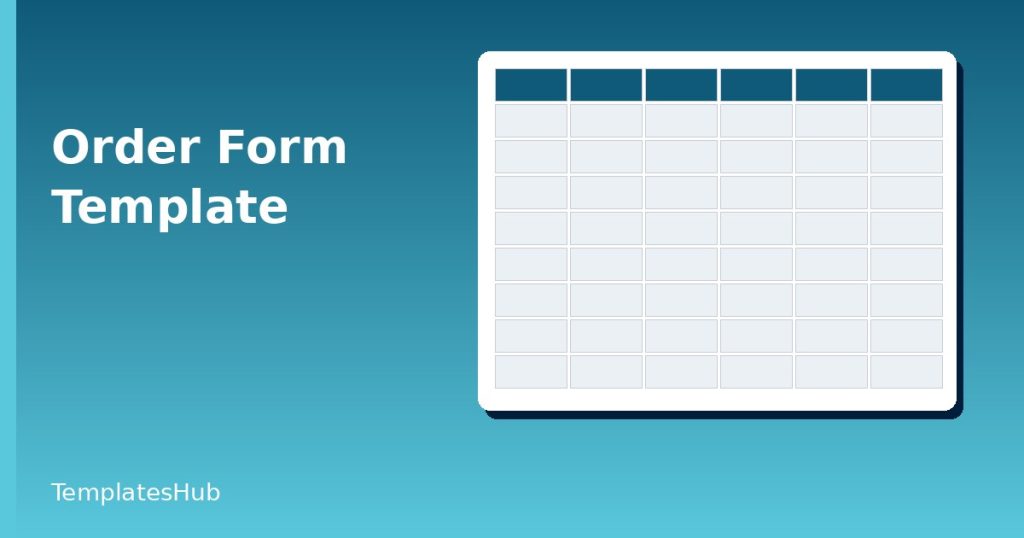
An order form template is a simple sheet that captures exactly what a customer wants, how many, and where it should go. Bakers, print shops, school fundraisers and wholesale suppliers all rely on one, because a vague message like “send me the usual” invites mistakes. Here is how to put together a form that people can complete in two minutes and you can act on without a follow-up call.
What Goes Into an Order Form Template
Think of the form as a conversation with all the questions asked in advance. Include these blocks, in this order.
- Your details: business name, address, phone, email and website.
- Order number and date: the number lets both sides refer to the same request.
- Customer details: name, company, billing address, delivery address, phone and email.
- Item table: product name or code, description, size or colour, quantity, unit price and line total.
- Totals: subtotal, discount, shipping, tax and amount due.
- Payment terms: accepted methods, deposit required, due date.
- Delivery or pickup: requested date and any special instructions.
- Signature and date, if you want written confirmation.
How to Fill It In Without Errors
- Write the order number from your running log. If you have none yet, start at 1001 so numbers look consistent.
- Enter the customer’s details exactly as supplied. Double-check the phone number by reading it back.
- Fill the table one product per row. Use the product code when you have one, since names can be ambiguous.
- Multiply quantity by price for each row, then total the column. In a spreadsheet, let formulas do this.
- Add shipping and tax last.
- Confirm the delivery date, and note anything unusual, such as a gate code or a delivery window.
- Send a copy back to the customer so they can confirm it matches what they meant.
Paper, Spreadsheet or Online Form?
Each format suits a different workflow. A printed form is perfect at a counter or a stall. A spreadsheet is best when you receive a handful of orders daily and want to sort, filter and sum them. An online form feeds answers into a sheet for you, which cuts retyping. If you start on paper, keep the layout simple enough that moving to a digital version later is trivial.
Whichever you pick, keep the order form template to one page. People abandon long forms, and any field you do not truly need is one more reason to give up.
Design Choices That Reduce Mistakes
Leave generous space for the address, since people write large. Use check boxes for fixed choices such as size, and a drop-down in digital versions. Mark required fields with an asterisk. Put the total in a bold box at the bottom right, where the eye naturally lands. If you sell items with options, add a “notes” column rather than letting customers squeeze details into the quantity cell.
Add a short line of terms near the bottom: return policy, lead time, and how to change an order. One or two sentences is plenty. It prevents arguments later without making the form look like a contract.
Handling Orders After They Arrive
Log each form the moment it comes in. A simple tracker with columns for order number, customer, date received, status and date shipped lets you see at a glance what is waiting. Acknowledge every order within a day, even if only with a two-line message. Customers who hear nothing tend to ask again, and then you handle the same order twice.
When stock is short, contact the customer before you substitute anything. Offer a delay, a different item or a refund, and record their choice on the original sheet.
Common Mistakes
The usual troubles are missing delivery addresses, unclear quantities such as “two boxes” when the box holds twelve, and forms without a date. Another is changing prices without updating the form. Review your order form template once or twice a year, and mark the version date in the footer so old copies are easy to spot.
FAQ
Is an order form the same as an invoice?
No. The order form records a request. The invoice asks for payment after you accept and fulfil it.
Do I need a signature?
Not always, but it helps for large or custom orders because it shows the customer agreed to the details.
How many items should the table hold?
Make room for what a typical customer buys, plus a few spare rows. Attach a second page for rare big orders.
Should prices be pre-printed?
If prices rarely change, yes. If they vary, leave the column blank or use a linked price list.
Related Templates

Written by thadmin_r7
The Templates Hub editorial team writes practical, plain-English guides for everyday readers.
More articles by this author →
Super Bowl Squares Template 2026: Printable Grid and Rules
Get a Super Bowl squares template 2026 setup: a 10x10 grid, how the digits work, payout ideas, and…

Budget Excel Template: Track Income, Bills and Savings
A budget Excel template adds totals and charts to your monthly plan. See how to set up sheets,…
To Do List Template: Layouts That Help You Finish Things
A to do list template helps you sort tasks by priority and deadline. See layouts that work, how…

Excel Calendar Template: Build and Use Your Own
An Excel calendar template updates dates automatically and prints cleanly. Learn where to find one, customise colours, add…