
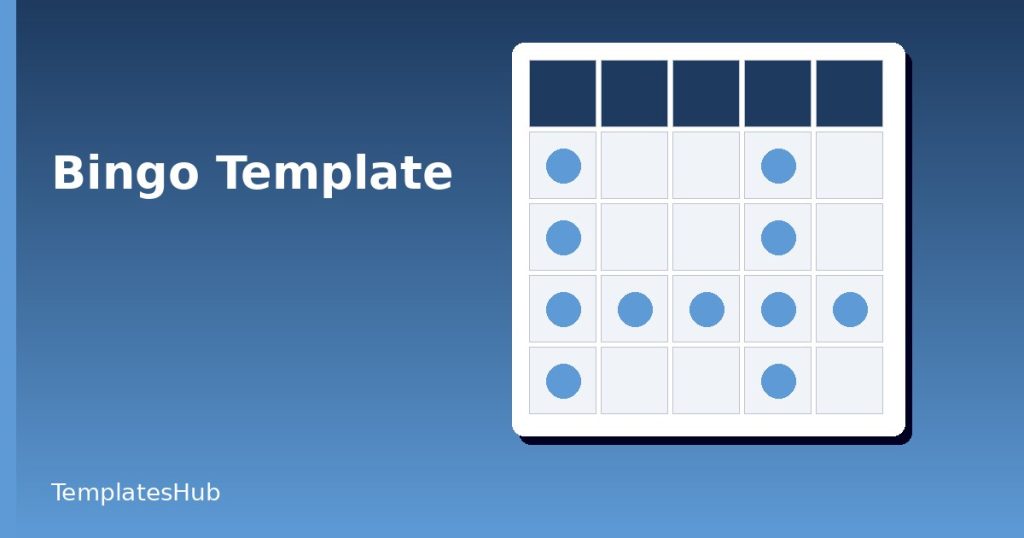
A bingo template makes it easy to build custom cards for a classroom, baby shower, office party or family night. Instead of the standard numbers, you can fill the grid with words, pictures, tasks or inside jokes. The format is familiar, so everyone understands it in seconds.
Choose a Grid Size
- 5 by 5 is classic, with 25 squares and often a free space in the middle.
- 4 by 4 is faster and suits young kids or short games.
- 3 by 3 works well for toddlers or quick icebreakers.
Bigger grids take longer to finish. If you only have fifteen minutes, go with 4 by 4 and call fewer items.
Decide What Goes in the Squares
Numbers are only one option. Some ideas:
- Classroom: vocabulary words, math answers, state capitals, sight words.
- Party: things guests might say, gifts a baby might receive, movie quotes.
- Work or meetings: common phrases on calls, team inside jokes, tasks completed.
- Travel: things you spot on a road trip, such as a red barn or a license plate from another state.
- Holiday: ornaments, treats, carols.
Aim for at least twice as many possible items as squares, so every card is different. For 24 squares you want 48 or more options, which gives plenty of variety.
Making Unique Cards
If every card is the same, everyone wins at once. Shuffle the items for each card. A simple way is to write your list in a spreadsheet, then use a random function to sort it for each player. You can also cut slips of paper, draw them from a bowl, and write them down in order.
For classroom sets, make 30 cards with different arrangements and number them on the back so you can check a winner later. Our Google Sheets templates page can help if you want to generate lists quickly.
Print and Prepare
- Print at actual size on letter paper or card stock.
- Use thicker paper if players will use markers that bleed through.
- Laminate cards for repeated use, or slide them into plastic sleeves and use dry-erase markers.
- Provide markers, dried beans, buttons or paper chips as markers.
- Print a separate caller sheet, or cut a duplicate list into slips to draw.
A margin of at least half an inch keeps printers from cropping the edge.
Design Tips
Make the font large enough to read from arm’s length, around 14 to 18 points for words. Keep squares equal in size. Use a bold title at the top and a clear free space in the center, perhaps with a star or the event name. Light borders and a plain background keep the card easy to read. Match colors to the theme, but keep contrast strong.
If you are printing an invitation or sign for the same event, see our free invitation templates for matching layouts.
How to Run the Game
- Hand out cards and markers.
- Explain the winning pattern: a row, column, diagonal, four corners, or a full card.
- Call items one at a time and repeat them.
- Players mark squares they have.
- The first to complete the pattern calls out “Bingo,” and you check the card against what you called.
- Offer a small prize and start again with a new pattern.
Variations
Try blackout (fill every square), letter X, or picture frame around the edges. For a group that talks a lot, make conversation bingo, where people tick a square when they hear a certain thing.
Common Mistakes
- Too few items, so cards look alike.
- Squares too small to write in.
- Forgetting to keep a record of what was called.
- Printing scaled down, which shrinks the grid and the text.
FAQ
How many cards do I need?
One per player, plus a few spares. For big groups, make unique cards so ties are less likely.
Can I make a bingo card in Word or Google Docs?
Yes. Insert a table with the right number of rows and columns, set equal row heights and widths, center the text, and add a title above.
Should the center square be free?
It is traditional in the 5 by 5 version. You can leave it free or fill it with a theme word.

Written by thadmin_r7
The Templates Hub editorial team writes practical, plain-English guides for everyday readers.
More articles by this author →
Gingerbread House Template: Print, Cut and Build Guide
A gingerbread house template saves guesswork. Learn how to print the pieces, cut dough accurately, bake flat panels…
Missing Poster Template: Make a Clear, Useful Flyer
A missing poster template helps you share key details fast. Learn what to include for a lost pet…
Comic Template: Panel Layouts for Strips and Short Stories
A comic template provides ready-made panels for strips, classroom stories and webcomics. Pick a layout, plan the beats…
Address Label Template: Set It Up and Print Without Misalignment
An address label template is a pre-measured grid that matches a sheet of sticky labels, so each name…